
Read more at home
Our family magazine
Explore our curriculum and approach to care, including the knowledge and science overview on page 13.
English PDF · 22 pages · 20.4 MB
Our connected curriculum
Stories, numbers, science, creativity and everyday independence connect through purposeful play. Educators notice each child’s next steps and plan experiences that revisit, deepen and extend understanding.
Our 40-week curriculum
Our curriculum brings together
Five age-specific pathways connect purposeful learning with your child’s interests, strengths and readiness. Educators observe, revisit and adapt, guided by an individualised learning plan.
Families stay connected through updates about their child’s current learning and individual progress.
Read more at home
Explore our curriculum and approach to care, including the knowledge and science overview on page 13.
English PDF · 22 pages · 20.4 MB
See the depth behind our curriculum
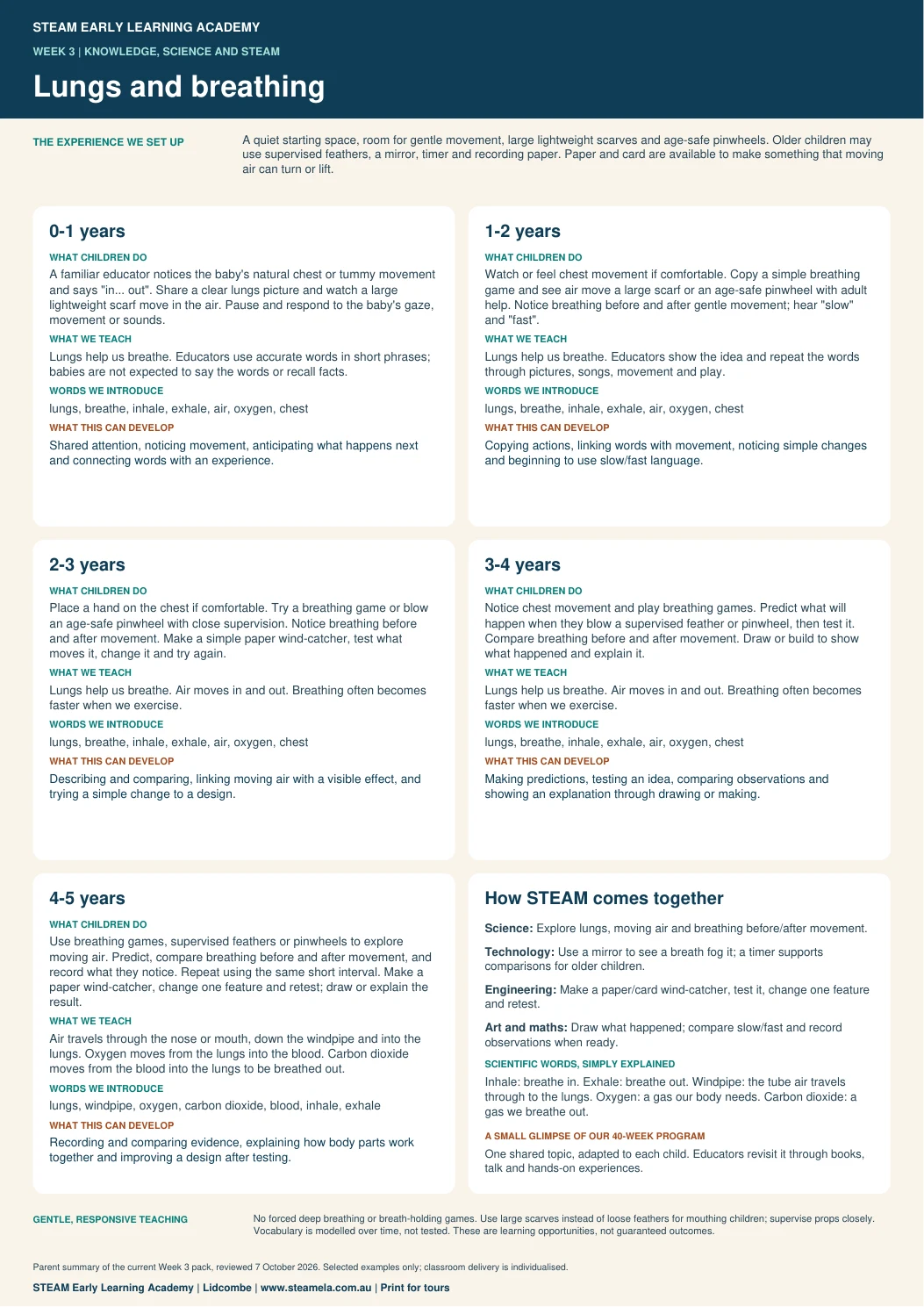
Hands on the chest, breathing games and moving scarves or pinwheels help children explore how breathing works. Preschoolers predict, test and compare breathing before and after movement, then draw or explain what happened.
Our A3 parent poster shows the setup, activities, core knowledge, key vocabulary and what this can develop across all five age groups. Younger children learn that lungs help us breathe; ages 4–5 also explore the windpipe, oxygen, blood and carbon dioxide. Educators adapt each experience to the child.
The printable poster is in English. Read the selected examples below in your chosen website language.
What children do: A familiar educator notices the baby's natural chest or tummy movement and says "in... out". Share a clear lungs picture and watch a large lightweight scarf move in the air. Pause and respond to the baby's gaze, movement or sounds.
What we teach: Lungs help us breathe. Educators use accurate words in short phrases; babies are not expected to say the words or recall facts.
Words we introduce: lungs, breathe, inhale, exhale, air, oxygen, chest
What this can develop: Shared attention, noticing movement, anticipating what happens next and connecting words with an experience.
What children do: Watch or feel chest movement if comfortable. Copy a simple breathing game and see air move a large scarf or an age-safe pinwheel with adult help. Notice breathing before and after gentle movement; hear "slow" and "fast".
What we teach: Lungs help us breathe. Educators show the idea and repeat the words through pictures, songs, movement and play.
Words we introduce: lungs, breathe, inhale, exhale, air, oxygen, chest
What this can develop: Copying actions, linking words with movement, noticing simple changes and beginning to use slow/fast language.
What children do: Place a hand on the chest if comfortable. Try a breathing game or blow an age-safe pinwheel with close supervision. Notice breathing before and after movement. Make a simple paper wind-catcher, test what moves it, change it and try again.
What we teach: Lungs help us breathe. Air moves in and out. Breathing often becomes faster when we exercise.
Words we introduce: lungs, breathe, inhale, exhale, air, oxygen, chest
What this can develop: Describing and comparing, linking moving air with a visible effect, and trying a simple change to a design.
What children do: Notice chest movement and play breathing games. Predict what will happen when they blow a supervised feather or pinwheel, then test it. Compare breathing before and after movement. Draw or build to show what happened and explain it.
What we teach: Lungs help us breathe. Air moves in and out. Breathing often becomes faster when we exercise.
Words we introduce: lungs, breathe, inhale, exhale, air, oxygen, chest
What this can develop: Making predictions, testing an idea, comparing observations and showing an explanation through drawing or making.
What children do: Use breathing games, supervised feathers or pinwheels to explore moving air. Predict, compare breathing before and after movement, and record what they notice. Repeat using the same short interval. Make a paper wind-catcher, change one feature and retest; draw or explain the result.
What we teach: Air travels through the nose or mouth, down the windpipe and into the lungs. Oxygen moves from the lungs into the blood. Carbon dioxide moves from the blood into the lungs to be breathed out.
Words we introduce: lungs, windpipe, oxygen, carbon dioxide, blood, inhale, exhale
What this can develop: Recording and comparing evidence, explaining how body parts work together and improving a design after testing.
These experiences are adapted to age, interests and readiness. Children can choose to observe. We do not use breath-holding competitions or force deep breathing; babies use large, safe props.
Language and reading
Books, conversation and sound awareness grow together, with learning matched to readiness.
Responsive talk, songs, rhymes and shared books build vocabulary and connection. Under two, we focus on language foundations without formal phonics.
Stories, conversation and brief playful sound-and-letter experiences build familiarity, without expectations to decode words.
Children explore sounds and letters, blending and segmenting, early writing and simple texts when ready. Understanding and a love of reading remain central.
Our running library
We want children to discover rich stories and language from a young age, and choose books for enjoyment and relaxation. Our running library helps families build this healthy habit and continue their child’s learning together at home.
Reading aloud introduces new words, builds language understanding and sparks conversation. Sharing a story also creates warm, unhurried time together, long before children can read independently.
Every child, including babies, chooses a book to take home. Read together in any language, return it in the library bag the following week and choose another.
Individual extension
Every child will have an individualised learning plan. Educators work with families to plan support, build on strengths and offer the next challenge.
During key learning moments, we commit to an extra educator above the required staffing minimum. Smaller groups allow more individual attention, targeted support and extension when children are ready.
Confident communicators
Rich conversations, group time, show-and-tell and weekly opportunities to share a topic build listening, communication and confidence. Educators adapt these experiences to each child; participation is never forced.
Emotions, communication and independence
Emotional coaching supports naming feelings, calming, problem-solving and repairing relationships. Everyday responsibilities and Montessori-inspired practical-life experiences build independence.
Our social-emotional program revisits body ownership, consent, boundaries, privacy and safe help-seeking every week. Children learn that their body belongs to them, they can say “no” or “stop”, and they must respect another person’s “stop”. They learn to tell a trusted adult if something feels wrong, confusing or unsafe—and keep telling until they receive help.
Teaching is gentle and matched to age and readiness: responsive care and respect for babies’ cues; simple words, stories and supported choices for toddlers; and puppets, role-play and everyday conversations for preschoolers. Educators explain necessary care, protect privacy and never require physical affection.
Come and meet us